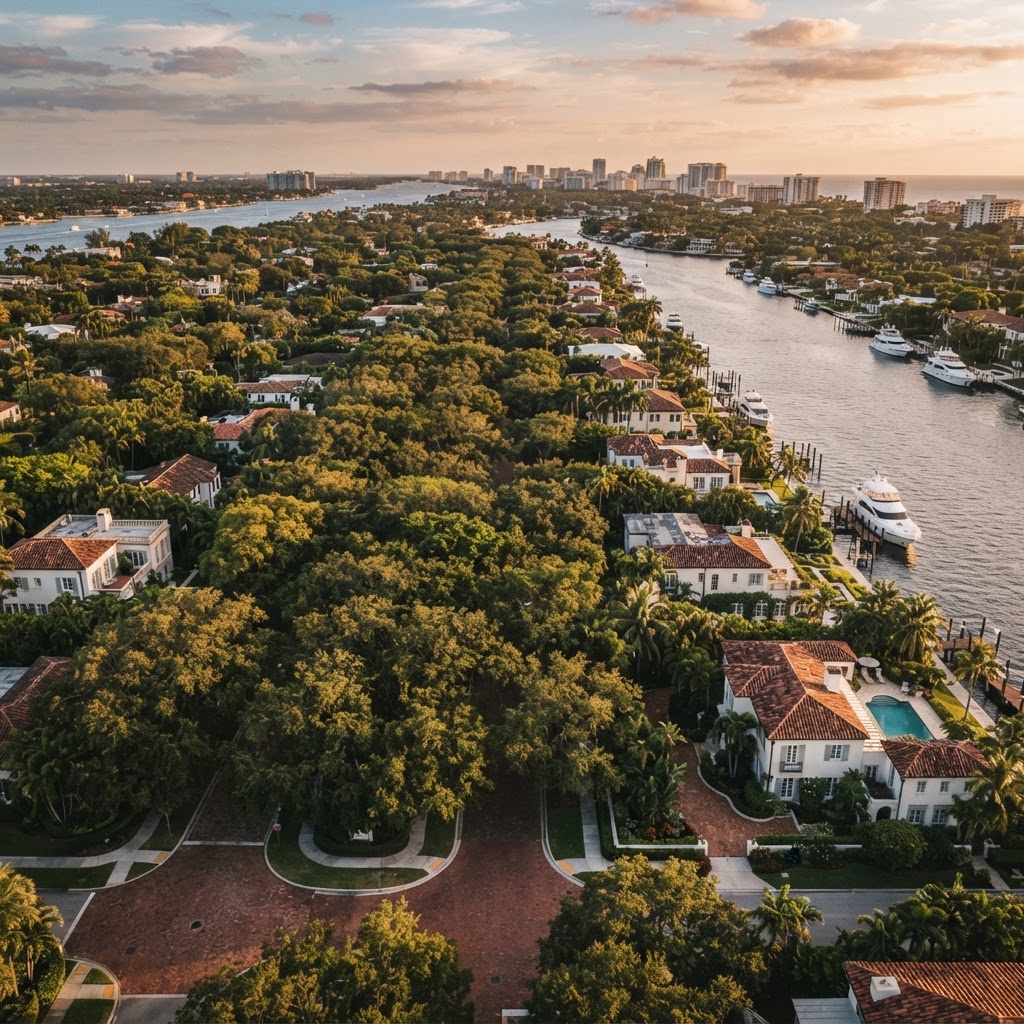
Colee Hammock
Old Florida Charm on the New River
Colee Hammock is a quiet, tree-canopied residential neighborhood in Fort Lauderdale, Florida, perched on a bend of the New River just west of the Intracoastal and a short walk from the heart of Las Olas Boulevard. One of Fort Lauderdale's oldest residential enclaves, it carries genuine history with brick-paved streets, mature live oaks draped with Spanish moss, and homes ranging from meticulously preserved 1930s estates to bold contemporary architecture. Its single defining characteristic is walkable proximity to Fort Lauderdale's best dining, shopping, and waterfront without the gates and formality of the city's newer luxury communities.
Colee Hammock is a quiet, tree-canopied neighborhood perched on a bend of the New River, just west of the Intracoastal and a short walk from the heart of Las Olas Boulevard. It is one of Fort Lauderdale's oldest residential enclaves, and unlike the city's newer luxury developments, it carries the texture of genuine history: brick-paved streets, mature live oaks draped with Spanish moss, and homes that range from meticulously preserved 1930s estates to bold contemporary architecture.
For buyers who want proximity to Fort Lauderdale's best dining, shopping, and waterfront without the gates and formality of the city's newer luxury communities, Colee Hammock offers a rare alternative. It feels like a neighborhood, not a compound. That character is precisely why it has become one of the most sought-after addresses in the market.
A Neighborhood with Roots
Colee Hammock's history dates to the early 1900s, when the Colee family settled the hammock, a slightly elevated stretch of land along the New River. By the 1920s and 1930s, the area had emerged as one of Fort Lauderdale's first fashionable residential districts, attracting winter visitors and year-round residents who built substantial homes beneath the natural oak canopy. Many of those original structures survive, and the neighborhood's older homes are prized for their architectural integrity and their deep, landscaped lots.
The neighborhood's name itself reflects its geography. A hammock is a term for a densely wooded, slightly elevated tract of land, and Colee Hammock's mature tree canopy remains its defining feature. Decades of resident advocacy and neighborhood governance have preserved that canopy even as surrounding areas have densified, giving the streets a shaded, intimate quality that newer developments simply cannot replicate.
Location, Without Compromise
Colee Hammock's location is its most powerful draw. The neighborhood sits between Southeast 9th Avenue and the Tarpon River, with the New River forming its northern boundary. Las Olas Boulevard, with its restaurants, galleries, boutiques, and nightlife, is reachable on foot in minutes. The downtown core, the Riverwalk, and the Broward Center for the Performing Arts are just across the river. For residents, that means the best of Fort Lauderdale is accessible without a car, a rarity in a city built around driving.
For boaters, the New River frontage offers direct access to the Intracoastal and the ocean, though with fixed bridges that limit vessel height. The neighborhood appeals to a different kind of waterfront buyer: those who want to live on the water for the lifestyle and the views, rather than those who need unrestricted mega-yacht dockage. That distinction is part of what gives Colee Hammock its character, it is a neighborhood of connoisseurs rather than pure boaters.
A Market That Continues to Mature
Colee Hammock has seen some of the most dramatic appreciation in Fort Lauderdale over the past decade, as buyers have rediscovered the value of a walkable, historically rooted neighborhood near the city's core. Homes here routinely sell for $3 million to $8 million, with waterfront estates and architecturally significant properties commanding premiums well beyond. The scarcity of available lots, combined with the neighborhood's protected character, means that supply is permanently limited.
For homeowners considering their next move, Colee Hammock represents a distinct proposition: the opportunity to own in a neighborhood whose value is anchored not just in waterfront or square footage, but in history, character, and location that cannot be manufactured. As Fort Lauderdale continues to grow and densify, that combination has only become more rare, and more sought after.
Colee Hammock FAQ
Where is Colee Hammock located?
Colee Hammock is a quiet, tree-canopied neighborhood perched on a bend of the New River, just west of the Intracoastal and a short walk from the heart of Las Olas Boulevard.
Is Colee Hammock a historic neighborhood?
Yes. Colee Hammock is one of Fort Lauderdale's oldest residential enclaves, with history dating to the early 1900s and brick-paved streets, mature live oaks, and preserved 1930s estates.
Is Colee Hammock walkable to Las Olas Boulevard?
Yes. Las Olas Boulevard's restaurants, galleries, boutiques, and nightlife are reachable on foot in minutes from Colee Hammock.
Does Colee Hammock have waterfront access?
Yes. The New River frontage offers direct access to the Intracoastal and the ocean, though fixed bridges limit vessel height, making it ideal for lifestyle and views rather than mega-yacht dockage.
Curious what your Colee Hammock home is worth in today's market? I'd love to talk through it with you.
Inquire