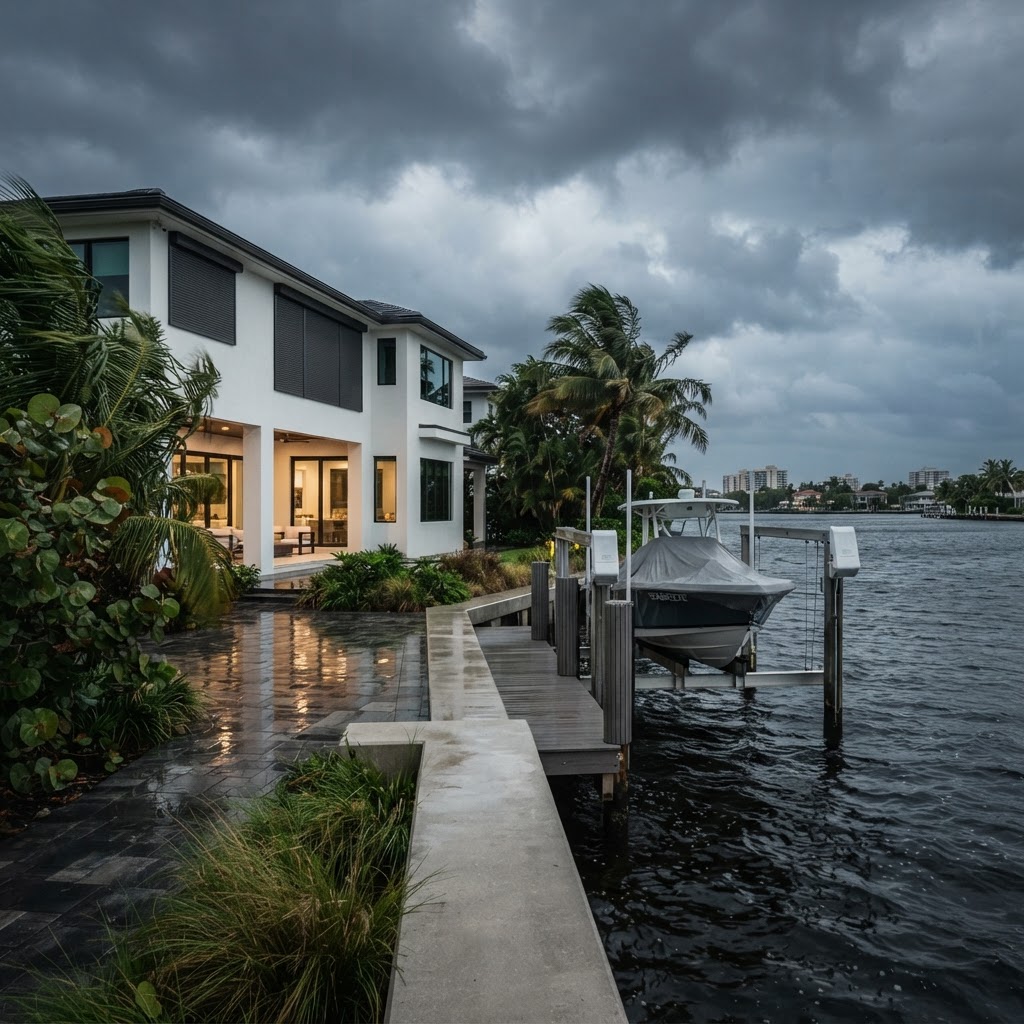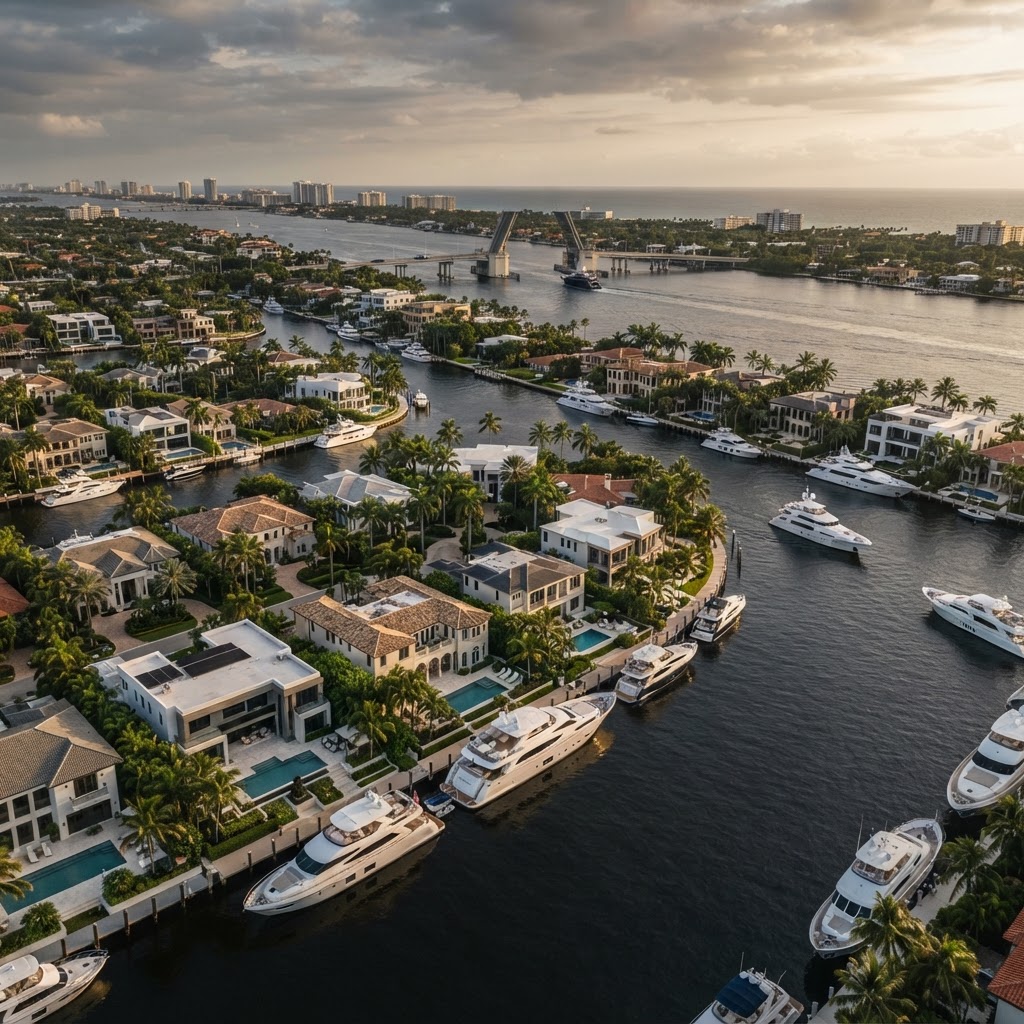
Seven Isles Has No Fixed Bridges. It Still Has Two Drawbridges on a Federal Schedule.
Seven Isles is 80 acres north of Las Olas Boulevard holding 315 households across seven islands, with the Intracoastal Waterway on its east and north edges. Running a boat from those docks to the ocean means clearing two drawbridges that open on a published federal schedule.
What Seven Isles Actually Is
Seven Isles sits north of Las Olas Boulevard. The Intracoastal Waterway forms its east and north boundaries. The neighborhood covers 80 acres and holds 315 households and roughly 1,145 residents.
The seven islands are Aqua Vista, Barcelona, Castilla, Del Mar, De Sota, Pelican Isle, and Sea Island. Buyers routinely file all of it under Las Olas Isles. It is a separate neighborhood on the other side of the boulevard, with its own association and its own rules.
The canals were cut by W.F. Morang, a developer who arrived from Boston in the early 1920s. His company dredged the canals and built the roads and bridges. The work stopped after the September 1926 hurricane.
The Two Drawbridges Between You and the Ocean
No fixed bridges is the line every waterfront home here is sold on. It is accurate. It is also not the whole trip.
Heading south on the Intracoastal toward the Port Everglades inlet, a boat leaving Seven Isles passes two drawbridges.
The East Las Olas bridge sits at mile 1064. Under the current federal rule it opens on the quarter hour and the three-quarter hour. That is twice an hour, at :15 and :45.
The Southeast 17th Street Causeway bridge, the Brooks Memorial, sits at mile 1065.9. Closed, it carries 55 feet of vertical clearance at mean high water. It opens on the hour and the half hour. From 6:50 a.m. to 9:10 a.m. and from 3:50 p.m. to 6:10 p.m., Monday through Friday except federal holidays, it opens once an hour at the top of the hour.
That last line is the one that changes a morning. A boat tall enough to need an opening leaves Seven Isles at 8:15 on a Tuesday and sits until nine.
No fixed bridges is true. No waiting is not.
Lot Width Decides What You Can Tie Up
Seven Isles was first platted in 50-foot lots. It was re-platted twice, between 1928 and 1937 and again between 1937 and 1952, into lots mostly wider than 75 feet.
That history is still in the ground. Two homes on the same canal can carry very different boats. Dock length follows the water frontage on the lot, not the address on the mailbox.
Ask for the platted frontage before you fall in love with the house.
The Association Funds Its Own Patrol
Residents formed the Seven Isles Homeowners' Association in 1986 and built a guardhouse. The association runs a 24/7 security patrol, paid for by the neighborhood itself.
That is a real amenity and a real cost line. Confirm the current assessment in writing before you close.
What to Confirm Before You Write an Offer
- The platted water frontage on the lot, not the number in the marketing copy
- Dock length, depth at the dock at mean low water, and the age of the seawall
- The current association assessment and exactly what the security fund covers
- Bridge timing on the run you would actually make, at the hour you would actually make it
- Flood zone and the elevation certificate for the structure
Who to Call
Lourdes Maestres has spent 17 years in the Fort Lauderdale market. She knows which canals in Seven Isles hold their depth, which lots kept the original 50-foot frontage, and what a seawall replacement costs here. A waterfront purchase turns on that level of detail.
If Seven Isles is on your list, reach out to Lourdes and the MPH Team. We will walk the dock with you before you write anything.
Want the real read on your neighborhood?
Connect with the luxury real estate agent Fort Lauderdale homeowners rely on for honest, data-driven guidance.
Schedule a Consultation